Why Most Shutdowns Fail — and How to Prevent It
Everything you need is right here.

Why Most Shutdowns Fail — and How to Prevent It
Industrial shutdowns are one of the most critical, costly, and complex operations in heavy industry. Yet, according to global benchmarking reports, over 80% of shutdowns exceed budget or schedule targets. In some cases, unplanned extensions can lead to millions in lost production per day, not to mention safety incidents, quality defects, and reputational damage. Why do these shutdowns go wrong — and more importantly, how can they go right?

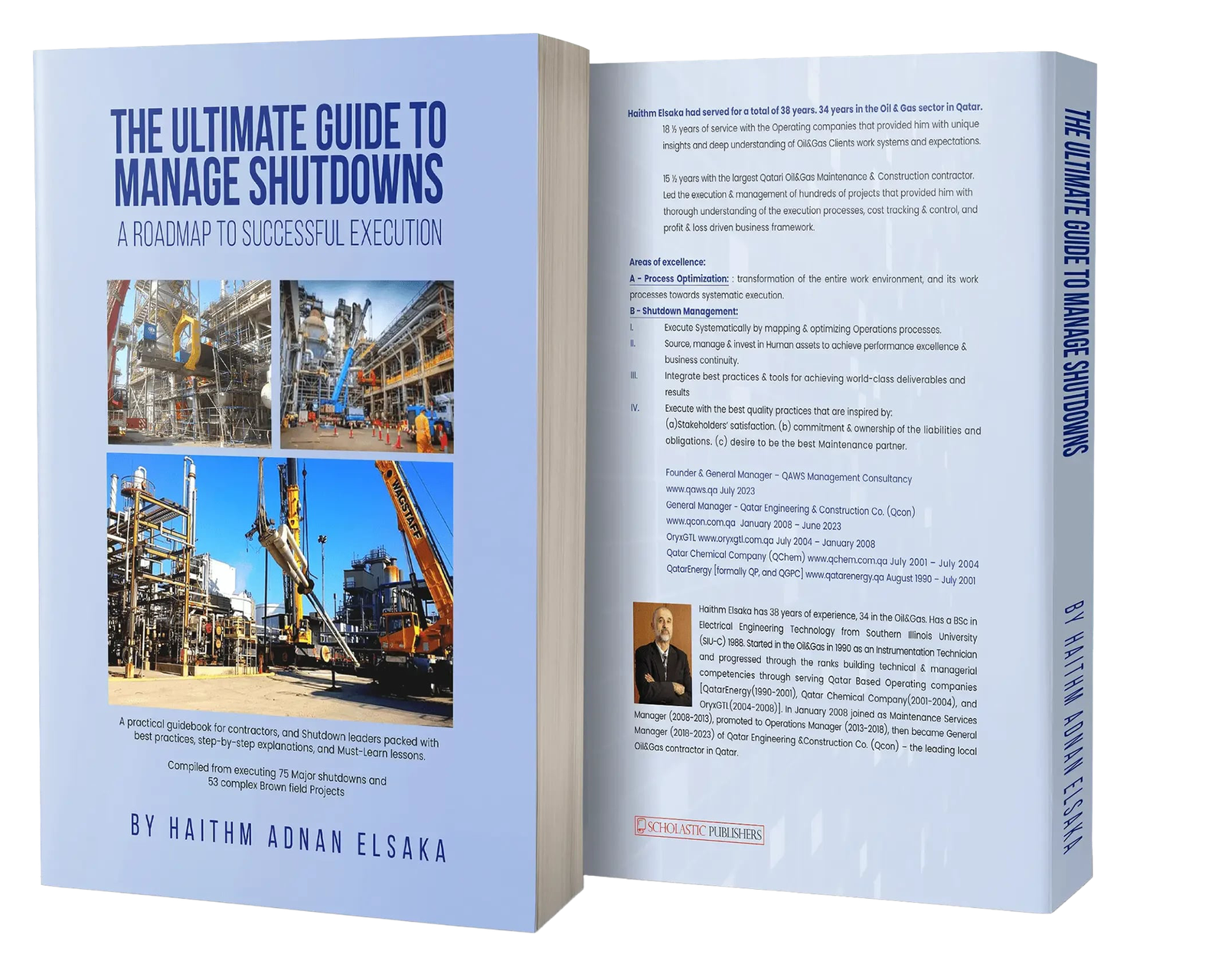
The answer lies not just in having experience but in having structure. Haithm Adnan Elsaka’s The Ultimate Guide to Manage Shutdowns explains that failure often starts well before the first bolt is turned. It begins with how shutdowns are planned, communicated, and controlled.
The first reason shutdowns fail is due to lack of commitment to the full completion of the Pre-SD phase. Too often, teams jump into execution while Pre-SD deliverables are incomplete and mitigations to overcome the missing deliverables are ignored. Elsaka lays out a time-bound strategy beginning at T-24 weeks. Each phase — initiation, scope definition, planning, pre-execution, execution, and closeout — is clearly defined with deliverables, gates, and review checkpoints. Without this structure, surprises become the norm.
Another major failure point is weak work breakdown structures (WBS). When tasks are grouped too broadly, there is no clarity on roles, sequence, or priorities. Elsaka emphasizes the use of detailed WBS and job packages, enabling accurate scheduling, resource allocation, and productivity tracking. This breaks complexity into control.
Ineffective communication also dooms many shutdowns. Whether it’s a mismatch between stakeholders or unclear command chains, confusion breeds errors. The book’s recommended Checklist methodology helps define who needs to do, know, what, when, and through which channel — from field coordinators to top management.
Then there’s scope creep, often disguised as undefined discovery jobs or last-minute requests. These balloon into delays, resources syphons, and budget blowouts. Elsaka promotes “scope freeze” and a rigorous approval process to control any change post-planning phase. This discipline allows teams to deliver what was agreed, on time.
Finally, many shutdowns fail to accurately and transparently report performance, cost and progress in real time. If you don’t continuously track safety, progress, cost, and quality, small deviations can escalate and derail the schedule..
Preventing shutdown failure doesn’t require magic. It requires a disciplined, documented, and deliberate approach. Elsaka’s roadmap offers exactly that — not just theory, but a working system tested in the field. If you want your next shutdown to succeed, don’t just plan it. Execute it the right way, from the very first day.
Talk to Haithm about your next shutdown
75 major shutdowns and 53 brownfield projects. Short, targeted engagements that move the needle.
We reply within two business day.